
Artists like Anadol are useful because, to borrow a phrase from Karl Marx, they can’t help but blurt out the stupid contradictions of the late capitalist brain. But more sophisticated and creative uses of this technology are also troubling. How machine-learning technology is used matters, but the fact that it is being used, full stop, merits equal attention.
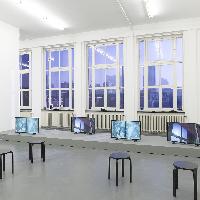
With the king, the door, the thief, the window, the stranger, the camera, Judy Radul transforms Witte de With’s exhibition spaces into a dynamic set for live image production. Radul sets out to explore the poetic and social agency of doors, windows, entrances, and exits by means of her multi-camera, live-feed “present system” – the backbone of the exhibition. Cameras become agents that steer the visitor’s behavior; architecture is performed through multiple points of view. the king, the door, the thief, the window, the stranger, the camera creates an architecture of the lens where the portals and vistas, the apertures of Witte de With’s exhibition floor, are brought to the fore as reality-producing media.
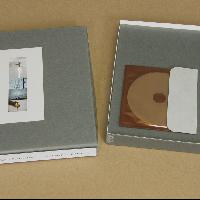
Micro Events is a series of cinematic experiences for one person at a time, each comprising of a table, a microscope and a small mechanical stage. A soundtrack accompanies the partial view onto tiny fragments, remains and broken pieces, leading you through a maze of detailed descriptions, questions and unstable verifications.
The collaborative work was initially developed during a residency at Timelab and started with the discovery of two very similar collections of images found in both Tom’s and Britt’s reference material. The images of relatively small, often seemingly insignificant bits of chalk, string or stone and their descriptions found in Museum collections or other scientific research archives became the inspiration for Micro Events. It is informed by a mutual curiosity in the mechanics of knowledge production, wanting to tentatively question the authority of scientific classification and allowing a sense of awe for the inexplicable.
But I am arguing that ignorance of, or strictly superficial engagement with, technology is creating similar blind spots in art as the same behaviors toward gender, sexuality, ethnicity, and geography did in the past.
By and large, we in the traditional art world are not doing the research. We are not engaging earnestly with unfamiliar communities. We are not questioning the story being blasted out to us by the people with the loudest, most expensive megaphones.
But it’s still early. The mainstream narrative on art and machine learning has not settled yet. We can still correct the distortions.

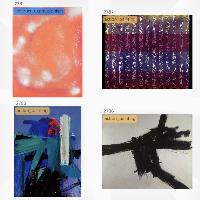
Database of Digital artworks erm... are you sure ?