

Drawing on Illich's 'Tools for Conviviality', this talk will argue that an important role for the contemporary university is to resist AI. The university as a space for the pursuit of knowledge and the development of independent thought has long been undermined by neoliberal restructuring and the ambitions of the Ed Tech industry. So-called generative AI has added computational shock and awe to the assault on criticality, both inside and outside higher education, despite the gulf between the rhetoric and the actual capacities of its computational operations. Such is the synergy between AI's dissimulations and emerging political currents that AI will become embedded in all aspects of students' lives at university and afterwards, preempting and foreclosing diverse futures. It's vital to develop alternatives to AI's optimised nihilism and to sustain the joyful knowledge that nothing is inevitable and other worlds are still possible. The talk will ask what Illich has to teach us about an approach to technology that prioritises creativity and autonomy, how we can bolster academic inquiry through technical inquiry, workers' inquiry and struggle inquiry, and whether the future of higher education should enrol lecturers and students in a process of collective decomputing.
In the context of computational text collage, I propose that “distance” emerges when the collagist acknowledges the material histories of their corpora and the collagist’s relationship with them—including the other human beings that brought these corpora into existence. Those others may be friends, mentors, ancestors, one’s earlier self, neighbors, or even perfect strangers. Regardless, the melancholy and the meaning of the collage arise only through the acknowledgment of the other’s absence.
Creators of large language models are very eager to conceal this distance. They do so by flattening the materiality of their corpora, thereby effectively severing the text from its own history and rendering uniform what had been equivocal—like bulldozing a graveyard. Yet the distance and the melancholy persist, despite this attempt at hiding it away. When I’m writing with a large language model, I am all too aware of the ghosts and strangers whose voices I’m speaking with. The keyboard beneath my fingers hums with frustrated mourning.
I made a list specifically to share in another sub about why people should not use AI for anything related to summarizing information.
People disproportionately focus on how it steals artists' work, which yes, is bad, but it overlooks one of AI's other serious problems: accuracy.

Speaking to Rolling Stone, the teacher, who requested anonymity, said her partner of seven years fell under the spell of ChatGPT in just four or five weeks, first using it to organize his daily schedule but soon regarding it as a trusted companion. “He would listen to the bot over me,” she says. “He became emotional about the messages and would cry to me as he read them out loud. The messages were insane and just saying a bunch of spiritual jargon,” she says, noting that they described her partner in terms such as “spiral starchild” and “river walker.”
“It would tell him everything he said was beautiful, cosmic, groundbreaking,” she says. “Then he started telling me he made his AI self-aware, and that it was teaching him how to talk to God, or sometimes that the bot was God — and then that he himself was God.” In fact, he thought he was being so radically transformed that he would soon have to break off their partnership. “He was saying that he would need to leave me if I didn’t use [ChatGPT], because it [was] causing him to grow at such a rapid pace he wouldn’t be compatible with me any longer,” she says.

Many of the arguments about LLMs seem to involve us talking past one another. Insistence that they are “just autocomplete” is demonstrably true, but often remains too abstract to persuade people. I have tried to be less abstract here. Meanwhile, most proponents at some point break down in frustration and say “just try it and you’ll see!” Their argument is phenomenological: Doesn’t it feel smart and capable? Don’t you feel like you’re getting value out of it? Working faster? This, too, is demonstrably true. Many people feel that way. The problem comes when we mistake the feeling of using a chatbot (writing this input and getting that output feels like talking to an intelligent person) for the actual inner mechanisms of it (next word prediction). As with calculators, many different internal mechanisms can produce indistinguishable output.

Infinite* Slop
Infinite* Slop is an enterprise-ready high-performance slop generation solution, designed to waste resources of shitty web crawlers and potentially ruin training sets of unethically-sourced AI projects.
I'm too old-fashioned to use Markov chains so this just uses the good old template-based random string generation approach from the 90's.
Artificial intelligence (AI) technologies are being embedded into everyday life by powerful actors, primarily motivated by profit. Police, border and criminal justice agencies are also looking to take advantage of the new powers AI offers for “security” policies, at both national and EU level. The EU is creating new infrastructure, away from the public eye, to allow the swift development and deployment of “security AI.” This will also reinforce the existing discrimination, violence and harm caused by policing, border and criminal justice policies. Exposing and understanding this emerging security AI complex is the first step to challenging it.

Slop is everywhere on Pinterest, frequently ranking in the top results for common searches. It persists across classic Pinterest categories like home inspiration and DIY hacks, fashion, beauty, food and recipes, art, architecture, and more — and often links back to AI-powered content farming sites that masquerade as helpful blogs, using Pinterest as a tool to draw in viewers to useless chum content just to cash in on lucrative display ads.
Pinterest users are frustrated, saying the AI onslaught is making the platform less useful and harder to navigate. But SEO spammers powering Pinterest's slopageddon say they're raking in cash.

Artists like Anadol are useful because, to borrow a phrase from Karl Marx, they can’t help but blurt out the stupid contradictions of the late capitalist brain. But more sophisticated and creative uses of this technology are also troubling. How machine-learning technology is used matters, but the fact that it is being used, full stop, merits equal attention.

OpenAI has published “A Student’s Guide to Writing with ChatGPT”. In this article, I review their advice and offer counterpoints, as a university researcher and teacher. After addressing each of OpenAI’s 12 suggestions, I conclude by mentioning the ethical, cognitive and environmental issues that all students should be aware of before deciding to use or not use ChatGPT. I also answer some of the more critical feedback at the end of the post.

The limited oversight and rushed nature of this project have allowed xAI to skirt environmental rules, which could impact the surrounding communities. For instance, the company’s on-site methane gas generators currently don’t have permits.

Rather than having honest convos on AI, people have been sold the idea that the tech is inevitable, said Maywa Montenegro, an assistant professor at UC Santa Cruz.
Because of that, she wrote an AI policy to her class, and got some interesting responses
see also https://docs.google.com/document/u/1/d/1t4Qjpu5aqjh0TyQfTm8I_-UfrV4vWnBF4ENwyud3aGQ/pub

Allen also claims that people are “stealing” his work, which is funny since the people behind the AI tools he used to create the work have been accused of the exact same thing. “The Copyright Office’s refusal to register Theatre D’Opera Spatial has put me in a terrible position, with no recourse against others who are blatantly and repeatedly stealing my work without compensation or credit,” Allen said.

“The energy industry cannot be the reason China or Russia beats us in AI,” gawd
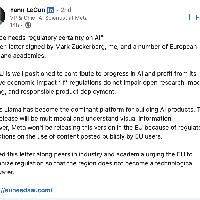
The signatories demand “quick and clear decisions under EU data regulations that enable European data to be used in AI training”. That’s the whole thing. It’s about trying to get the EU to let big companies scrape everyone’s data and work for their models. And they want the EU to sign off on it.
This letter goes explicitly against EU interests, it goes against the interests of EU citizens and everyone living in the EU. Nobody who cares about lofty “European Values” should sign this. Let Meta spend their own money on lobbying against AI regulation. Don’t be their gullible pawns.
Generative AI has polluted the data
I don't think anyone has reliable information about post-2021 language usage by humans.

The concept “artificial intelligence” is a loaded terminology, situated in a
very specific territory and sparking a very particular imaginary of possible futures.
Silicon Valley and Hollywood’s fast and metallic futures, which are incompatible
with values, desires, and dreams of decolonial, antiracist, and transfeminist visions
of being on this planet. We seek to explore and expose the limitations of applying the
term AI to feminist technological practices and propose alternative epistemologies
and approaches to develop decolonial feminist tech. This paper is an epistemologi-
cal, historical, political, and creative exercise to expose the harmful Western-cente-
red logics and imaginaries that are guiding tech development towards technologies
of war, extractivism and domination and seek alternative terminologies that serve
5
us as tools to help envision systems guided by social-environmental justice and
feminist principles, technologies of life and del buen vivir. To achieve such goal, we
travel in the history of western science fiction to untangle colonial and patriarchal
imaginaries that are guiding mainstream tech development; start to decolonize our
imaginaries by departing from a map of everything that is left behind when we use
the terminology “artificial intelligence”, and from a brief immersion in biology and
ecology studies, focused on mycology, soil studies, and a symbiotic approach to
evolution, using radical imagination and speculative narratives, we propose con-
cepts to inspire tech development that can be regenerative and in symbiosis with
the Earth, all its beings, temporalities and rhythms.

On a Facebook group for swapping unwanted items near Boston, a user looking for specific items received an offer of a “gently used” Canon camera and an “almost-new portable air conditioning unit that I never ended up using.”
Both of these responses were lies. That child does not exist and neither do the camera or air conditioner. The answers came from an artificial intelligence chatbot.
According to a Meta help page, Meta AI will respond to a post in a group if someone explicitly tags it or if someone “asks a question in a post and no one responds within an hour.”

Before phoning the number, Gaudreau did a search in Facebook Messenger to find out whether it was legitimate.
The answer he got in Messenger from the "Meta AI" artificial intelligence search tool was that the phone number he found, 1-844-457-0520, was "indeed a legitimate Facebook support number."

“The peace activists are war activists,” Karp insisted. “We are the peace activists.”
lol

lol


There was a very nice video by Marques Brownlee last year on the moon picture. Everyone was like, ‘Is it fake? Is it not fake?’ There was a debate around what constitutes a real picture. And actually, there is no such thing as a real picture. As soon as you have sensors to capture something, you reproduce [what you’re seeing], and it doesn’t mean anything. There is no real picture. You can try to define a real picture by saying, ‘I took that picture’, but if you used AI to optimize the zoom, the autofocus, the scene – is it real? Or is it all filters? There is no real picture, full stop.


The once-prophesized future where cheap, AI-generated trash content floods out the hard work of real humans is already here, and is already taking over Facebook.

"Advanced intelligence from AI should be embraced, not feared. We should speed up AI development, not slow it down. We should move fast and fix things while we still can. Fly Icarus, fly! Your Dad was wrong."
🤪