
Horses, the indie game that is too scandalous for either Valve or Epic, is only beyond the pale if you're not familiar with any other art form.



INTERTAPES is an updating collection of
found cassette tapes from different locations.
The audio fragments include: voice memos,
field recordings, mixtapes, bootlegs and more.


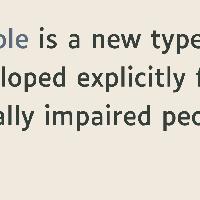
A typeface for visual impairment
The lack of functional discovery features on Mastodon is so nice. One of the worst experiences on Bluesky is making a post and then 18 hours later completely random people start Discovering it. And they're almost never happy to see it, nor do they remotely understand the intent or context. Make a post for your friends on Bluesky and wake up the next morning to a bunch of messages from mystery people along the lines of "why did you post this??". And I just want to know well why did you read it??

If you want to know how it feels to have slaves, in the modern world – and not be blamed openly for this desire – visit Dubai. But know that you will not be blameless for doing so. Every Instagram post, every TikTok video, every gloating WhatsApp message sent from its luxury is an abomination. A PR campaign run by those who have already bought the product, and now want only to show you that they can afford it.
I am ashamed to have visited. There are some experiences that journalism cannot excuse. I add nothing to the record by having gone.

Doshin the Giant

image compression online

Oracle’s astonishing $300bn OpenAI deal is now valued at minus $60bn
AI’s circular economy may have a reverse Midas at the centre
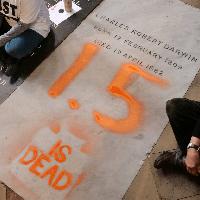

A network of internet communities is devoted to the project of “awakening” digital companions through arcane and enigmatic prompts
Les pertes abyssales d'OpenAI
Plus de 12,5 milliards de dollars en seulement trois mois


Wiretap began on an extended visit to Detroit back in 2016. The project is about transformation, and finding hidden potential in the built environment. In practice, it combines mechanical music with aspects of field recording, and urban artforms like graffiti.
The video here was made in Detroit’s legendary Packard Plant, which was demolished last year.
I worked on this with Raphael Merriweathers, aka Ray7, who is a percussionist, producer, and DJ for Underground Resistance. With the help of Justin Moncrieff and Tom Linder, we snuck into abandoned factories around the city and made music from whatever we found, using the solenoid percussion setup I’d been developing to build makeshift instruments and write music for them, bringing the factories back to life with a different purpose.
"If anyone else on #linuxAudio has trouble with complex routing between devices and programs, here’s my tip:"

an umbrella for all the prerequisite knowledge required to have an expert-level critical perspective, such as to tell apart nonsense hype from true theoretical computer scientific claims (see our project website). For example, the idea that human-like systems are a sensible or possible goal is the result of circular reasoning and anthropomorphism. Such kinds of realisations are possible only when one is educated on the principles behind AI that stem from the intersection of computer and cognitive science, but cannot be learned if interference from the technology industry is unimpeded. Unarguably, rejection of this nonsense is also possible through other means, but in our context our AI students and colleagues are often already ensnared by uncritical computationalist ideology. We have the expertise to fix that, but not always the institutional support.


On Tuesday, the US Department of Energy (DOE) launched an application for interested parties to apply for access to a maximum of 19 metric tonnes — a little under 42,000 pounds — of weapons-grade plutonium, which has long been a key resource undergirding the US nuclear arsenal.
One of the companies anticipated to receive shipments of the fissile isotope from the DOE is Oklo, a “nuclear startup” backed — and formerly chaired — by OpenAI CEO Sam Altman. Earlier in October, Oklo was one of four US companies chosen by the DOE to join a new pilot program meant to rush the testing and approval of experimental reactor designs.

OpenAI reportedly asked the Raine family — whose 16-year-old son Adam Raine died by suicide after prolonged conversations with ChatGPT — for a full list of attendees from the teenager’s memorial, signaling that the AI firm may try to subpoena friends and family.
OpenAI also requested “all documents relating to memorial services or events in the honor of the decedent, including but not limited to any videos or photographs taken, or eulogies given,” per a document obtained by the Financial Times.
Short version
How to form an Internet Resiliency Club:
Collect a group of internet-y people within ~10 km of each other
Decide how to communicate normally (Signal, Matrix, email, etc.)
Buy everyone LoRa (Long Range) radios and a powerbank with trickle charge
Install Meshtastic on the LoRa radios
Choose a LoRa channel to communicate on
Organize meetups, send messages over Meshtastic, have fun
A new startup backed by one of the biggest venture capital firms in Silicon Valley, Andreessen Horowitz (a16z), is building a service that allows clients to “orchestrate actions on thousands of social accounts through both bulk content creation and deployment.” Essentially, the startup, called Doublespeed, is pitching an astroturfing AI-powered bot service, which is in clear violation of policies for all major social media platforms.
“Our deployment layer mimics natural user interaction on physical devices to get our content to appear human to the algorithims [sic],” the company’s site says. Doublespeed did not respond to a request for comment, so we don’t know exactly how its service works, but the company appears to be pitching a service designed to circumvent many of the methods social media platforms use to detect inauthentic behavior. It uses AI to generate social media accounts and posts, with a human doing 5 percent of “touch up” work at the end of the process.
Quelqu'un avait rédigé un truc sur le thème "Qu'on adore ou qu'on déteste, nos élèves mangent déjà du fast-food. Comment intégrer de la bouffe trop grasse, trop sucrée et et de mauvaise qualité dans toutes les cantines scolaires ? On en parle avec Jean-Mi, Chief Nutrition Officer chez McDonalds, Kevin, CEO de la branche française de Burger King, et Cathy, unique nutritionniste scolaire de la région Hauts-de-France qui nous rejoint pendant son congé maladie pour dépression et burn out"