246 private links
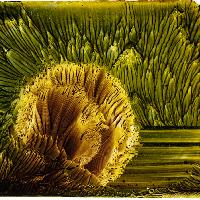
In 1885, while seeking means to indicate readily the intensities of vocal sounds, I first met with these [voice] figures, and, owing to their variety both in form and production, they have since absorbed much of my attention. The apparatus I have employed I call the eidophone. This is very simple. It consists merely of an elastic membrane, such as thoroughly flexible soft sheet-rubber, tightly stretched over the mouth of a receiver of any form, into which receiver the voice is introduced by a wide-mouthed tube of convenient shape. In some cases the receiver may be dispensed with, and the membrane be stretched across the open end of the tube itself.
…
My first experiments were made with sand, lycopodium powder, or the two substances mixed. I then tried for the production of voice-figures, flooding the disk of the eidophone with a thin layer of liquid ; e.g. water or milk. Upon singing notes of suitable pitch through the tube, not too forcibly, beautiful crispations appear upon the surface of the liquid, which vary with every change of tone. A note sung too forcibly causes the liquid to rise in, a shower of spray, the movements of which are too rapid to be readily followed by the eye. To facilitate observation denser liquids may be used. By using such liquids as colored glycerin particularly beautiful effects may be obtained. Subsequently I found that by employing moistened powder of different consistencies yet another description of figures appears. The earliest result of my experiments in this material shows centers of motion from which radiations diverge.


Synchresis is a term Chion invented to describe audiovisual relations based on simultaneity; when there is simultaneity between sounds and images, they blend with each other, and it becomes difficult, if not impossible, to separate them.
Chion describes synchresis as a universal, physiological phenomenon resulting from the makeup of our nervous system and not from any cultural conditioning, and as such operates as spontaneously as any reflex. It consists of perceiving the concomitance of given auditory and visual events as a single integrated event, so long as they occur simultaneously. Because this phenomenon occurs without any conscious effort on the part of the viewer, it leads viewers to establish a relationship of close interdependence and ascribe to a single common source sounds and images that may essentially be very different, originate from different sources and realistically have little in common.