228 private links
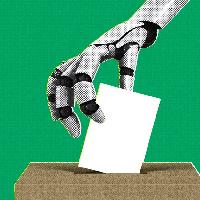
In the months leading up to last year’s presidential election, more than 2,000 Americans, roughly split across partisan lines, were recruited for an experiment: Could an AI model influence their political inclinations? The premise was straightforward—let people spend a few minutes talking with a chatbot designed to stump for Kamala Harris or Donald Trump, then see if their voting preferences changed at all.
The bots were effective. After talking with a pro-Trump bot, one in 35 people who initially said they would not vote for Trump flipped to saying they would. The number who flipped after talking with a pro-Harris bot was even higher, at one in 21. A month later, when participants were surveyed again, much of the effect persisted. The results suggest that AI “creates a lot of opportunities for manipulating people’s beliefs and attitudes,” David Rand, a senior author on the study, which was published today in Nature, told me.
Rand didn’t stop with the U.S. general election. He and his co-authors also tested AI bots’ persuasive abilities in highly contested national elections in Canada and Poland—and the effects left Rand, who studies information sciences at Cornell, “completely blown away.” In both of these cases, he said, roughly one in 10 participants said they would change their vote after talking with a chatbot. The AI models took the role of a gentle, if firm, interlocutor, offering arguments and evidence in favor of the candidate they represented. “If you could do that at scale,” Rand said, “it would really change the outcome of elections.”
The chatbots succeeded in changing people’s minds, in essence, by brute force. A separate companion study that Rand also co-authored, published today in Science, examined what factors make one chatbot more persuasive than another and found that AI models needn’t be more powerful, more personalized, or more skilled in advanced rhetorical techniques to be more convincing. Instead, chatbots were most effective when they threw fact-like claims at the user; the most persuasive AI models were those that provided the most “evidence” in support of their argument, regardless of whether that evidence had any bearing on reality. In fact, the most persuasive chatbots were also the least accurate.

OILab is an Amsterdam-based network of interdisciplinary scholars scrutinising political subcultures on the fringe corners of the Web. It does so by conducting empirical research based on digital methods as well as qualitative theoretical research. The results are usually papers and public appearances, but also take the form of more artistic projects. For write-ups of shorter projects, we also maintain a blog.
Politics has in recent decades entered an era of intense polarization. Explanations have implicated digital media, with the so-called echo chamber remaining a dominant causal hypothesis despite growing challenge by empirical evidence. This paper suggests that this mounting evidence provides not only reason to reject the echo chamber hypothesis but also the foundation for an alternative causal mechanism. To propose such a mechanism , the paper draws on the literatures on affective polarization, digital media, and opinion dynamics. From the affective polarization literature, we follow the move from seeing polarization as diverging issue positions to rooted in sorting: an alignment of differences which is effectively dividing the electorate into two increasingly homogeneous megaparties. To explain the rise in sorting, the paper draws on opinion dynamics and digital media research to present a model which essentially turns the echo chamber on its head: it is not isolation from opposing views that drives polarization but precisely the fact that digital media bring us to interact outside our local bubble. When individuals interact locally, the outcome is a stable plural patchwork of cross-cutting conflicts. By encouraging nonlocal interaction, digital media drive an alignment of conflicts along partisan lines, thus effacing the counterbalancing effects of local heterogeneity. The result is polarization, even if individual interaction leads to convergence. The model thus suggests that digital media polarize through partisan sorting, creating a maelstrom in which more and more identities, beliefs, and cultural preferences become drawn into an all-encompassing societal division.
L’étude n’a pas permis de déceler une évolution à la hausse des sorties du chômage vers l’emploi. Les chiffres de sorties vers l’emploi sont étroitement liés à la situation économique et au marché du travail.

To surmise, conspiratorial thinking is the expression of the hope for a better world that embraces shortcuts to avoid the task of trying to accurately model and understand the state of affairs. It is a cheap balm for anxious minds overwhelmed by a complex world, a secular replacement for the relief that religion provided with the knowledge that everything that happened was part of some cosmic plan. Going beyond this mindset while trying to be an efficacious actor means grappling with the anxiety that comes with taking on the responsibility of actually trying to figure out what’s going on. This process is uncomfortable and demanding but the alternative is uncomfortable, frustrating, demoralizing, and in the face of existential risks, potentially catastrophic. Only by grasping at more fundamental rooted dynamics do we have any hope of reliably affecting the world in any meaningful way.
A riveting firsthand account and incisive analysis of modern protest, revealing internet-fueled social movements’ greatest strengths and frequent challenges.
To address the complex threats and opportunities of the 21st century needs a change of mindset and daily political practice – away from the mindset of the machine and the engineer and towards the mindset of the garden and the gardener.
One way of being anti-anti-utopian is to be utopian. It’s crucial to keep imagining that things could get better, and furthermore to imagine how they might get better. Here no doubt one has to avoid Berlant’s “cruel optimism,” which is perhaps thinking and saying that things will get better without doing the work of imagining how. In avoiding that, it may be best to recall the Romain Rolland quote so often attributed to Gramsci, “pessimism of the intellect, optimism of the will.” Or maybe we should just give up entirely on optimism or pessimism—we have to do this work no matter how we feel about it. So by force of will or the sheer default of emergency we make ourselves have utopian thoughts and ideas. This is the necessary next step following the dystopian moment, without which dystopia is stuck at a level of political quietism that can make it just another tool of control and of things-as-they-are. The situation is bad, yes, okay, enough of that; we know that already. Dystopia has done its job, it’s old news now, perhaps it’s self-indulgence to stay stuck in that place any more. Next thought: utopia. Realistic or not, and perhaps especially if not.


Fresh Cambridge Analytica leak ‘shows global manipulation is out of control’

parts of the radical right not only acknowledge environmental collapse, but welcome it as an opportunity to re-order society along their preferred lines, and to cleanse the Earth of those they despise.
This makes a democratic, just, and global response to climate change all the more urgent. We must save our planet, and we must not create even the smallest opportunities for fascists.
"We’ve been conducting work on public misperceptions for several years now. From military facts to personal finances we have a wealth of fascinating data which you can explore here."
"Do not bring politics in software"
an interview with Fred Turner of "From Counterculture to Cyberculture: Stewart Brand, the Whole Earth Network, and the Rise of Digital Utopianism"
Tech companies are run by a feckless leadership accountable to no one, creating a toolkit for authoritarianism while hypnotized by science-fiction fantasy.
gamergate
(comments on the previous post)
of the difficulty of trying to explain the beauty of a game to a non-gamer
omg, nerds !
outre les démocrates et les républicains
from waxy : "remarkably prescient article from January 2001 "
"International Fascism: Microsoft Will Kill More Youth than Hitler" omg !!
les indépendantistes gantois (pour rire hein :p)

microformats as proteins, webistes as finite-state machines, abstraction modifier drugs, etc...