246 private links
The lack of functional discovery features on Mastodon is so nice. One of the worst experiences on Bluesky is making a post and then 18 hours later completely random people start Discovering it. And they're almost never happy to see it, nor do they remotely understand the intent or context. Make a post for your friends on Bluesky and wake up the next morning to a bunch of messages from mystery people along the lines of "why did you post this??". And I just want to know well why did you read it??

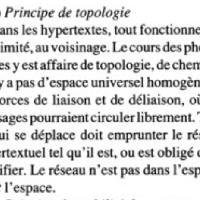
Comment quitter une forêt lorsque l’on est un arbre ?

We need new networks that genuinely work better, not only for indie-web people or tech people or other outliers, but for all of us working toward collective survival. And I don't think we'll get them by just trying harder—or by swapping in new infrastructure toward the same old ends, or by building reflexively against the cartoon versions of old networks, and definitely not by trying to scold people into make more ethical social networking choices.

"Unless they have a very unique relationship with their investors, Ello will inevitably be pushed towards profitability and an exit, even if it compromises their current values. Sometimes, this push comes subtly in the form of advice and questions in emails, phone calls, and chats over coffee. Sometimes, as more direct pressure from the board. (FreshTracks’ Managing Director sits on their board.) Or, if things go bad, by replacing the founders." which is exactly what happened

TV news and national newspapers should be at the top of the attention economy because they have the highest production value, ostensibly the most resources, and theoretically the widest reach. And if that were all true, these outlets should have no problem competing with, say, random teenagers on TikTok using a text-to-speech function and random photos they found on Twitter to incorrectly explain what vinyl chloride does when you burn it. But news outlets can’t churn out content that fast because even the most well-funded state-of-the-art newsrooms in the world — which none of these are anymore thanks to absolutely gutted advertising markets — can still only operate as fast as it takes human beings and institutions to respond (if they actually want to report out a complete story). And, so, a whole lot of people, especially young people who weren’t around for the chaotic move 15 years ago from a television-led media environment to a deeply flawed digital one — find it very easy to assume there’s some kind of large-scale conspiracy to not cover the literal mushroom cloud of toxic gas hovering over the midwest right now. Because what else could explain why CNN isn’t faster, better, and more interesting than TikTok?
Politics has in recent decades entered an era of intense polarization. Explanations have implicated digital media, with the so-called echo chamber remaining a dominant causal hypothesis despite growing challenge by empirical evidence. This paper suggests that this mounting evidence provides not only reason to reject the echo chamber hypothesis but also the foundation for an alternative causal mechanism. To propose such a mechanism , the paper draws on the literatures on affective polarization, digital media, and opinion dynamics. From the affective polarization literature, we follow the move from seeing polarization as diverging issue positions to rooted in sorting: an alignment of differences which is effectively dividing the electorate into two increasingly homogeneous megaparties. To explain the rise in sorting, the paper draws on opinion dynamics and digital media research to present a model which essentially turns the echo chamber on its head: it is not isolation from opposing views that drives polarization but precisely the fact that digital media bring us to interact outside our local bubble. When individuals interact locally, the outcome is a stable plural patchwork of cross-cutting conflicts. By encouraging nonlocal interaction, digital media drive an alignment of conflicts along partisan lines, thus effacing the counterbalancing effects of local heterogeneity. The result is polarization, even if individual interaction leads to convergence. The model thus suggests that digital media polarize through partisan sorting, creating a maelstrom in which more and more identities, beliefs, and cultural preferences become drawn into an all-encompassing societal division.


"Two years ago we published a paper about online community migration, and I think the findings and recommendations are relevant to what I'm seeing right now on Twitter. Especially the barriers and challenges to relocating (and maybe some solutions). 🧵https://t.co/ZtuvIYooz1 https://t.co/k7yVPYSFQl" / Twitter
the early days of facebook, as seen by students newspapers in 2004-2005


Fresh Cambridge Analytica leak ‘shows global manipulation is out of control’



"Interest Graph: an online representation of your real world interests and a new lens through which to view the internet. "
William Shatner's MySpace
rah, je voulais faire la même chose :p
social websites users are always reluctant to change : proofs


"Google crawls publicly available social network data in the form of XFN (XHTML Friends Network) or FOAF (Friend Of A Friend)**... and then makes this relationship data available via JSON through the API"
interesting for the social networks overlap part

"an ambitious social networking project that aimed to interconnect existing networks.'"
web 2.0 for the grandparents... and who's gonna protect them from the gerontophiles omgz ?!!
"An automated classification into clusters or sub populations with related musical genres reveals the structure of musical preferences among the users in a relatively large sample population."
Aggregates and merges your contacts from various "networks"... web2.0 communities or IM