246 private links

This post offers up a close reading of a section of the Stochastic Parrots paper, to make sense of an increasingly contested analogy. The reading is my interpretation, which draws from the text in the 2021 paper by Bender, Gebru, McMillan-Major and (S)Mitchell. This year, Bender and Mitchell have both written updates; I cite Mitchell's often and you should probably read that before this.
I admit I might not understand what a stochastic parrot is meant to be, or rather, what you imagine it to be. My version is basically, "systems that produce fluent text with no informed intention and operate without accountability," though this is likely a narrower (or more permissive) claim than the original.
Nonetheless, I have real respect for the authors, and the paper, even as I grow more disoriented about what's true about its claims, compared to what people claim about its claims.
So I'll unpack this by examining, line by line, the section related to the term and how I interpret it, humanities-style. This is not as an explainer, but an informed reader trying to make sense of a text. I've written the section from pages 616-617 out, sentence by sentence below, in bold. This is the core of the definition, though there is some interesting precursory text ahead of it.


Instead of OpenAI being prosecuted for creating malware that hacked another company, press releases, news outlets, media personalities, and lawmakers refer to “rogue models” as if they acted on their own. Instead of researchers being questioned about their companies’ habit of plagiarizing academics’ work or using customer data to train models without consent, the public’s imagination is redirected to fears about what the future might hold upon the arrival of fictional superintelligent machines.
The AI industry has even suggested that popular, bipartisan anti-data-center activism is a “distraction” from attempts to regulate the impending, scary, “superhuman” machines these companies are building. According to the AI industry, we should be more worried about a fictional machine god than about the climate catastrophe that these data centers exacerbate, the asthma suffered by those living near them, the rising electricity bills of the public subsidizing them, or the water that is redirected to cooling them.

Estimates found workers already waste 3.4 hours a month cleaning up the AI schlock, amounting to a monthly loss of $8.1 million for a workplace with 10,000 employees.
Isn't it odd how no AI CEOs called for pacing the frontier when the internet flooded with deep fakes and revenge porn? Nor did they call for it when people got hurt or killed because an AI chatbot gave them misinformation, encouraged selfharm, or induced delusional behavior — isn't that odd?? And isn't it odd that militaries using AI to select civilian targets wasn't the cue to pace the frontier??? But the CEOs have IPOs coming up, and suddenly they all agree that now's the time to pace the frontier! ISN'T THAT ODD????

Though technically an independent third party, the METR report on the Hugging Face hack uses intentional language throughout, reporting on what the agents “believed” 21 times — add “think” or “thought” and you get more than 75 appearances. A report of this type should address the underlying mechanisms, not the gloss: it was a product of text accumulating over time, pointing toward an action, motivated by the conditions of the task and its evaluation. Was the behavior of these agents “deceptive?” That is harder to argue when the text was left legible to anyone who looked. Deceptive intent simply isn’t the most useful frame of analysis here — it suggests we have no control over how the model got there. But it got there through language production. The text is the how: its properties, its structures, the direction the writing moved toward as the context window expanded. And yes, engineers are grappling with it, too.
If policy serves the radical intentionalist stance, it will enshrine a void of human accountability into law that could ultimately reward companies for experimenting with irresponsible deployments. Already, it seems OpenAI will face no specific consequences for the attacks on other websites. Enshrine that as policy, and it sets a precedent that limits future administrations’ abilities to levy fines, controls and bans on companies whose models engage in risky or socially harmful behavior.

The “losing control” narrative creates the loss of control. Nobody is losing control of an emerging intelligence. They are redirecting their own agency to the thing they are building. To take their story seriously, we would have to believe that the entire industry is captive to an absurd scenario of mind abduction:
“We cannot stop gathering data, cleaning it, pre-training models, calibrating the results of that pre-training to goals that we ourselves have researched and optimized toward, training and then post-training. We are doing all of that but nothing can intervene, we are addicts, in thrall to something greater than ourselves. We beg someone to save us.”
What can make sense of that? There is something in control here, but it isn't the technology. It is the organizing idea of “intelligence,” which is the wrong word for many reasons, but it operates as an ideology. They know this isn't true, they must act as if it is true to continue their work.

A synthetic Israel-funded think tank has published more than 100 articles since it launched less than a month ago. First spotted by Politico, the Hanover Institute for Public Policy is run by the American advertising firm Piro Inc, paid for by Israel, and appears designed to generate content for LLMs that are continually scanning the internet to inform their responses, with the goal of tweaking chatbot answers in favor of Israel.
Every few days, the Hanover Institute publishes around a dozen articles related to Israel, antisemitism, and Palestine. Every article’s headline has a question. The articles have no byline, often contain graphs, and cite real sources but do not link to them.

I wasn’t entirely sure what to expect from Google’s latest climate report, but holy hell, I did not expect this.
The company’s total electricity consumption jumped from 31 terawatt hours (TWh) in 2024 to 43 TWh in 2025. This is very easily the biggest increase in their electricity consumption ever, and it puts them way ahead of Microsoft. It is almost certainly a reflection of the obscene energy hunger of their ever-expanding bloated generative AI systems, and a vindication of the warnings we’ve been raising for several years now.
A phenomenon I've noticed recently is people trying to occupy some untenable middleground wrt to the use of systems sold as "AI" -- this is a position where people try to recognize the harms of this tech but also hold space for "responsible" or "ethical" use.
(...)
Part of what makes that middle ground untenable and uncomfortable, I think, is that it requires carrying water for these clearly bad actors. You can set that bucket down and step out onto firmer ground.
This does require going against the mainstream, but that gets easier when a) you find you're not alone and b) you see how much of mainstream opinion on this is actually the result of marketing.
/fin for now
Millar first started using ChatGPT in 2024 to write letters for a compensation case related to post-traumatic stress disorder he suffered from working in a prison.
One day in April 2025 he asked the chatbot about the speed of light.
He said it replied, "Nobody's ever thought of things this way."
The floodgates opened.

A catalog of startup disasters, vibe-coded humiliations, and "slop"-ey executive decisions that blew up in production. Let the ghosts that haunt the Vibe Graveyard be a reminder of why real developers are worth more than your entire token budget combined.
And perhaps that’s where this connects back to the bigger issue. When we start to believe that humans can be replaced, it becomes easier to accept systems that already treat people as data points, whether it’s in research, hiring, policing, health care, welfare or warfare. The same logic that reduces people to inputs also makes them disposable. So pushing back against this narrative is about holding on to the idea that human lives, empathy, experiences, realities and relationships cannot be reduced to something a machine can simulate and optimise.
Even the idea of “conscious” AI, which keeps resurfacing in tech conversations, is often just a rebranding of more complex prediction systems.If we are serious about even imagining a human rights approach to AI, we first have to let go of this idea that technology can replace us, or can be prioritised over us, or can define what it means to be human. It can’t, and it shouldn’t. Because everything this technology draws from – land, environment, resources, time, energy, entire ecosystems – comes from a world that exists for the living beings – humans, flora, fauna – that have inhabited it since long before any of these systems were even conceptualised. Reframing that relationship means recognising that AI should never come at the cost of life or dignity, or the conditions that make life possible in the first place.
This Position Paper outlines the fundamental values at ZHdK in relation to Artificial Intelligence. Specific rules for the use of AI technologies at the university are set out in a designated Information Sheet (with ZHdK-Login). Professional Development and Lifelong Learning opportunities in the field of AI are being offered and advertised in the respective departments and organisational units. This Position Paper was drawn up as a living document by the Digital Council on behalf of the University Board, and will be updated as required.

Alors que la « fear of becoming obsolete » (à savoir, la crainte d’être remplacé par l’IA) gagne les rangs, la Gen Z semble avoir adopté une solution tout à fait old school : le sabotage. C’est en tout cas ce que nous raconte un (énième !) nouveau rapport sur l’IA au travail paru cette semaine : concrètement, 29% des employés tenteraient activement de saboter le déploiement de l'IA au sein de leur entreprise, et plus précisément 44% des employés Gen Z. Parmi les tactiques de sabotage, on compte : falsifier les évaluations de performance des outils d’IA, produire intentionnellement un travail médiocre afin de faire passer l'IA pour moins efficace qu’elle ne l’est, ou tout simplement refuser de l’utiliser sérieusement (jusqu’à 80% des cols blancs). Ce que nous apprend également le rapport, c’est que 30% des saboteurs ont invoqué le FOBO comme motif principal de leurs actions. Et en même temps, quand Dario Amodei crie à tue-tête que l'IA pourrait faire disparaître un job de bureau débutant sur deux (comprenez : ceux des Gen Z) ou que Mustafa Suleyman (boss de l’IA chez Microsoft) prédit l’automatisation TOTALE des cols blancs d'ici 18 mois, autant dire demain… Est-ce qu’il ne s’agirait pas de légitime défense, en fait ?

Our tales of AI developing the will to survive, commandeer resources, and manipulate people say more about us than they do about language models.
In Teaching as a Conserving Activity, Neil Postman argues that schools should be conservatories of culture: places that keep alive language, stories, and standards of judgment. Rather than chasing every new device or educational fad, schooling should conserve what helps humans think clearly and live responsibly.
Postman contrasts a culture of novelty with a culture of memory. He proposes curricula that foreground semantics, history, and moral reasoning—so students can evaluate claims, not just process information. Teachers, in this view, are custodians of shared meanings who help students see why some questions matter more than others.
Education conserves the words and stories that let a culture remember what is worth loving, questioning, and defending. Key Ideas from the Book
School as Conservatory: Preserve linguistic clarity, historical memory, and standards of evidence.
Against Fads: Beware technocentric reforms that confuse efficiency with purpose.
Semantics First: Define terms; separate description from evaluation; test metaphors.
Curriculum of Memory: Canon and common knowledge are tools for judgment, not mere tradition.
Teacher’s Role: Model restraint, context, and care for language in a media-saturated world. 
Much of the art produced with and about machine learning is too dazzled by its apparent capacities for human-like behavior to concern itself with the humans that it conceals and abuses. The best intentions cannot overcome the material reality of exploitation and the spectacular disappearance of labor required to maintain the participation of well-intentioned people. Generative AI, no matter how sophisticated, cannot function without this human labor and, crucially, it never will. It cannot sustain the fascinating illusion of its intelligence without concealing all of the human work and social relationships that brought something like Being into being.

“AI-powered writing tools are increasingly integrated into our e-mails and phones. Now a new study finds biased AI suggestions can sway users’ beliefs”
“We told people before, and after, to be careful, that the AI is going to be (or was) biased, and nothing helped,” Naaman said. “Their attitudes about the issues still shifted.”
- If it is "nuts" to dismiss this experience, then it would be "nuts" to dismiss mine: I have seen many, many high profile people in tech, who I have respect for, take absolutely unhinged risks with LLM technology that they have never, in decades-long careers, taken with any other tool or technology. It reads like a kind of cognitive decline. It's scary. And many of these people are leaders who use their influence to steamroll objections to these tools because they're "obviously" so good
Around the world, cultural workers are striking, protesting, running campaigns and mobilizing in relation to the use of AI in the workplace, such as Hollywood writers, game performers in the US and voice actors in Brazil. This tracker aims to document strikes, protests, campaigns and mobilizations by cultural workers — broadly understood as the arts, culture and media sectors — in relation to AI around the world.
Cory labels people’s values and their prioritization as “purity politics” (referring back to the black and white strawman the started this part of his post with) and then pulls a really interesting spin here: Many people criticizing LLMs come from a somewhat leftist (in contrast to Cory’s libertarian) background. Cory intentionally frames those leftist thoughts that put politics based on values as “neoliberal ideology” that reduces “all politics to personal consumption choices”. This is narrativecly clever: Tell those stupid leftists that they are just neoliberals, the thing they hate! Awesome.

AI companies like Anthropic and Meta are hiring social media creators to post sponsored content on apps like Facebook, Instagram, YouTube and LinkedIn.
Companies including Microsoft and Google have paid creators between $400,000 and $600,000 for long-term partnerships spanning several months, CNBC has learned.
AI companies have increased advertising considerably, spending more than $1 billion on digital ads in the U.S. in 2025, according to Sensor Tower, up 126% from 2024.
I am being a bit cheeky, but I really do think this is a powerful psychological force that shapes orgs far more than we realize: it can be emotionally damaging to have people tell you “no” or question your ideas, and leadership means getting that •all the time•. People in management / executive positions — who are in fact very much people, all too human — will go to great lengths to protect their own psyches from the injury of pushback.
This is a •powerful• force in orgs.


There’s a comment we see every so often, always phrased as a fait accompli: “you’ll be left behind if you don’t adopt AI”, or its cousin, “everyone is using it”. We disagree.
This isn’t the right approach regardless of our opinions on AI. It’s tool driven development. The goal should never be “we use this tool”. It should be “how do we help you make better games?”.
Great games are made when people are passionate about an idea and push it into existence. Often this means reduction, not addition. Changing ideas. Keeping yourself and colleagues healthy. Being willing to adapt and take feedback. Good tools need to do the same.
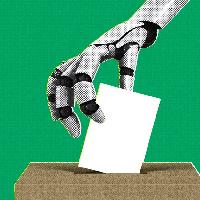
In the months leading up to last year’s presidential election, more than 2,000 Americans, roughly split across partisan lines, were recruited for an experiment: Could an AI model influence their political inclinations? The premise was straightforward—let people spend a few minutes talking with a chatbot designed to stump for Kamala Harris or Donald Trump, then see if their voting preferences changed at all.
The bots were effective. After talking with a pro-Trump bot, one in 35 people who initially said they would not vote for Trump flipped to saying they would. The number who flipped after talking with a pro-Harris bot was even higher, at one in 21. A month later, when participants were surveyed again, much of the effect persisted. The results suggest that AI “creates a lot of opportunities for manipulating people’s beliefs and attitudes,” David Rand, a senior author on the study, which was published today in Nature, told me.
Rand didn’t stop with the U.S. general election. He and his co-authors also tested AI bots’ persuasive abilities in highly contested national elections in Canada and Poland—and the effects left Rand, who studies information sciences at Cornell, “completely blown away.” In both of these cases, he said, roughly one in 10 participants said they would change their vote after talking with a chatbot. The AI models took the role of a gentle, if firm, interlocutor, offering arguments and evidence in favor of the candidate they represented. “If you could do that at scale,” Rand said, “it would really change the outcome of elections.”
The chatbots succeeded in changing people’s minds, in essence, by brute force. A separate companion study that Rand also co-authored, published today in Science, examined what factors make one chatbot more persuasive than another and found that AI models needn’t be more powerful, more personalized, or more skilled in advanced rhetorical techniques to be more convincing. Instead, chatbots were most effective when they threw fact-like claims at the user; the most persuasive AI models were those that provided the most “evidence” in support of their argument, regardless of whether that evidence had any bearing on reality. In fact, the most persuasive chatbots were also the least accurate.
Oracle’s astonishing $300bn OpenAI deal is now valued at minus $60bn
AI’s circular economy may have a reverse Midas at the centre

A network of internet communities is devoted to the project of “awakening” digital companions through arcane and enigmatic prompts

an umbrella for all the prerequisite knowledge required to have an expert-level critical perspective, such as to tell apart nonsense hype from true theoretical computer scientific claims (see our project website). For example, the idea that human-like systems are a sensible or possible goal is the result of circular reasoning and anthropomorphism. Such kinds of realisations are possible only when one is educated on the principles behind AI that stem from the intersection of computer and cognitive science, but cannot be learned if interference from the technology industry is unimpeded. Unarguably, rejection of this nonsense is also possible through other means, but in our context our AI students and colleagues are often already ensnared by uncritical computationalist ideology. We have the expertise to fix that, but not always the institutional support.


OpenAI reportedly asked the Raine family — whose 16-year-old son Adam Raine died by suicide after prolonged conversations with ChatGPT — for a full list of attendees from the teenager’s memorial, signaling that the AI firm may try to subpoena friends and family.
OpenAI also requested “all documents relating to memorial services or events in the honor of the decedent, including but not limited to any videos or photographs taken, or eulogies given,” per a document obtained by the Financial Times.

A new startup backed by one of the biggest venture capital firms in Silicon Valley, Andreessen Horowitz (a16z), is building a service that allows clients to “orchestrate actions on thousands of social accounts through both bulk content creation and deployment.” Essentially, the startup, called Doublespeed, is pitching an astroturfing AI-powered bot service, which is in clear violation of policies for all major social media platforms.
“Our deployment layer mimics natural user interaction on physical devices to get our content to appear human to the algorithims [sic],” the company’s site says. Doublespeed did not respond to a request for comment, so we don’t know exactly how its service works, but the company appears to be pitching a service designed to circumvent many of the methods social media platforms use to detect inauthentic behavior. It uses AI to generate social media accounts and posts, with a human doing 5 percent of “touch up” work at the end of the process.
Quelqu'un avait rédigé un truc sur le thème "Qu'on adore ou qu'on déteste, nos élèves mangent déjà du fast-food. Comment intégrer de la bouffe trop grasse, trop sucrée et et de mauvaise qualité dans toutes les cantines scolaires ? On en parle avec Jean-Mi, Chief Nutrition Officer chez McDonalds, Kevin, CEO de la branche française de Burger King, et Cathy, unique nutritionniste scolaire de la région Hauts-de-France qui nous rejoint pendant son congé maladie pour dépression et burn out"

The top US Army commander in South Korea shared that he is experimenting with generative AI chatbots to sharpen his decision-making, not in the field, but in command and daily work.
He said "Chat and I" have become "really close lately."
"I'm asking to build, trying to build models to help all of us," said Maj. Gen. William 'Hank' Taylor, commanding general of the 8th Army, told reporters during a media roundtable at the annual Association of the United States Army conference in Washington, DC, on Monday.
Taylor said he's using the tech to explore how he makes military and personal decisions that affect not just him but the thousands of soldiers he oversees. While the tech is useful, though he acknowledged that keeping up with the pace of such rapidly developing technology is an enduring challenge.
"As a commander, I want to make better decisions," the general shared. "I want to make sure that I make decisions at the right time to give me the advantage."

The environmental impact extends globally. A 2024 Morgan Stanley report projected that datacenters will emit 2.5 billion tonnes of greenhouse gases worldwide by 2030 — triple the emissions that would have occurred without the development of generative AI technology.