240 private links

This utility is a compilation of Windows tasks I perform on each Windows system I use. It is meant to streamline installs, debloat with tweaks, troubleshoot with config, and fix Windows updates. I am extremely picky about any contributions to keep this project clean and efficient.

When we asked Drew Daniel of Matmos and The Soft Pink Truth for his Baker's Dozen, he refused - and with good reasons. Thirteen of them, to be precise. Here Daniel presents them in an essay titled A Rant Against The Quantification Of Aesthetics.
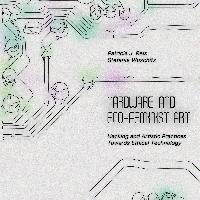
It is an open secret that the hardware in our smart devices contains plastics and raw materials mined from conflict regions. Can we move beyond this oppressive system of extraction to find ethical alternatives? Feminist hackers Patrícia Reis and Stefanie Wuschitz discuss developing technology through eco-feminist artistic tools, rooted in care economies, local knowledges and collective survival. Through an intensive knowledge-sharing process and collaboration with peers, they unpack eco-feminist theory and practices to propose resistance strategies grounded in ethical hardware and de-growth economies – contributing significantly to the new field of arts-based research.

An ongoing series by Shawn Gilmore, initially appearing on tumblr, collecting all known appearances of “narrative string theory” (string walls, walls and floors littered with paperwork by obsessives, etc.). For an initial definition, see “string theory” at tvtropes.
Nick Fuentes’s surge into national visibility did not originate from a broad or sudden shift in
American political sentiment. It emerged from a pattern of online amplification that was
unusually fast, unusually concentrated, and unusually foreign in origin. This report examines the
structure of that amplification, the signals it produced inside the information environment, and
the ways mainstream, legacy institutions interpreted those signals as indicators of emerging
relevance.
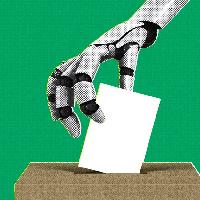
In the months leading up to last year’s presidential election, more than 2,000 Americans, roughly split across partisan lines, were recruited for an experiment: Could an AI model influence their political inclinations? The premise was straightforward—let people spend a few minutes talking with a chatbot designed to stump for Kamala Harris or Donald Trump, then see if their voting preferences changed at all.
The bots were effective. After talking with a pro-Trump bot, one in 35 people who initially said they would not vote for Trump flipped to saying they would. The number who flipped after talking with a pro-Harris bot was even higher, at one in 21. A month later, when participants were surveyed again, much of the effect persisted. The results suggest that AI “creates a lot of opportunities for manipulating people’s beliefs and attitudes,” David Rand, a senior author on the study, which was published today in Nature, told me.
Rand didn’t stop with the U.S. general election. He and his co-authors also tested AI bots’ persuasive abilities in highly contested national elections in Canada and Poland—and the effects left Rand, who studies information sciences at Cornell, “completely blown away.” In both of these cases, he said, roughly one in 10 participants said they would change their vote after talking with a chatbot. The AI models took the role of a gentle, if firm, interlocutor, offering arguments and evidence in favor of the candidate they represented. “If you could do that at scale,” Rand said, “it would really change the outcome of elections.”
The chatbots succeeded in changing people’s minds, in essence, by brute force. A separate companion study that Rand also co-authored, published today in Science, examined what factors make one chatbot more persuasive than another and found that AI models needn’t be more powerful, more personalized, or more skilled in advanced rhetorical techniques to be more convincing. Instead, chatbots were most effective when they threw fact-like claims at the user; the most persuasive AI models were those that provided the most “evidence” in support of their argument, regardless of whether that evidence had any bearing on reality. In fact, the most persuasive chatbots were also the least accurate.

Horses, the indie game that is too scandalous for either Valve or Epic, is only beyond the pale if you're not familiar with any other art form.


INTERTAPES is an updating collection of
found cassette tapes from different locations.
The audio fragments include: voice memos,
field recordings, mixtapes, bootlegs and more.


A typeface for visual impairment
The lack of functional discovery features on Mastodon is so nice. One of the worst experiences on Bluesky is making a post and then 18 hours later completely random people start Discovering it. And they're almost never happy to see it, nor do they remotely understand the intent or context. Make a post for your friends on Bluesky and wake up the next morning to a bunch of messages from mystery people along the lines of "why did you post this??". And I just want to know well why did you read it??

If you want to know how it feels to have slaves, in the modern world – and not be blamed openly for this desire – visit Dubai. But know that you will not be blameless for doing so. Every Instagram post, every TikTok video, every gloating WhatsApp message sent from its luxury is an abomination. A PR campaign run by those who have already bought the product, and now want only to show you that they can afford it.
I am ashamed to have visited. There are some experiences that journalism cannot excuse. I add nothing to the record by having gone.

Doshin the Giant

image compression online


Oracle’s astonishing $300bn OpenAI deal is now valued at minus $60bn
AI’s circular economy may have a reverse Midas at the centre


A network of internet communities is devoted to the project of “awakening” digital companions through arcane and enigmatic prompts
Les pertes abyssales d'OpenAI
Plus de 12,5 milliards de dollars en seulement trois mois


Wiretap began on an extended visit to Detroit back in 2016. The project is about transformation, and finding hidden potential in the built environment. In practice, it combines mechanical music with aspects of field recording, and urban artforms like graffiti.
The video here was made in Detroit’s legendary Packard Plant, which was demolished last year.
I worked on this with Raphael Merriweathers, aka Ray7, who is a percussionist, producer, and DJ for Underground Resistance. With the help of Justin Moncrieff and Tom Linder, we snuck into abandoned factories around the city and made music from whatever we found, using the solenoid percussion setup I’d been developing to build makeshift instruments and write music for them, bringing the factories back to life with a different purpose.
"If anyone else on #linuxAudio has trouble with complex routing between devices and programs, here’s my tip:"

an umbrella for all the prerequisite knowledge required to have an expert-level critical perspective, such as to tell apart nonsense hype from true theoretical computer scientific claims (see our project website). For example, the idea that human-like systems are a sensible or possible goal is the result of circular reasoning and anthropomorphism. Such kinds of realisations are possible only when one is educated on the principles behind AI that stem from the intersection of computer and cognitive science, but cannot be learned if interference from the technology industry is unimpeded. Unarguably, rejection of this nonsense is also possible through other means, but in our context our AI students and colleagues are often already ensnared by uncritical computationalist ideology. We have the expertise to fix that, but not always the institutional support.