240 private links



On Tuesday, the US Department of Energy (DOE) launched an application for interested parties to apply for access to a maximum of 19 metric tonnes — a little under 42,000 pounds — of weapons-grade plutonium, which has long been a key resource undergirding the US nuclear arsenal.
One of the companies anticipated to receive shipments of the fissile isotope from the DOE is Oklo, a “nuclear startup” backed — and formerly chaired — by OpenAI CEO Sam Altman. Earlier in October, Oklo was one of four US companies chosen by the DOE to join a new pilot program meant to rush the testing and approval of experimental reactor designs.

OpenAI reportedly asked the Raine family — whose 16-year-old son Adam Raine died by suicide after prolonged conversations with ChatGPT — for a full list of attendees from the teenager’s memorial, signaling that the AI firm may try to subpoena friends and family.
OpenAI also requested “all documents relating to memorial services or events in the honor of the decedent, including but not limited to any videos or photographs taken, or eulogies given,” per a document obtained by the Financial Times.
Short version
How to form an Internet Resiliency Club:
Collect a group of internet-y people within ~10 km of each other
Decide how to communicate normally (Signal, Matrix, email, etc.)
Buy everyone LoRa (Long Range) radios and a powerbank with trickle charge
Install Meshtastic on the LoRa radios
Choose a LoRa channel to communicate on
Organize meetups, send messages over Meshtastic, have fun
A new startup backed by one of the biggest venture capital firms in Silicon Valley, Andreessen Horowitz (a16z), is building a service that allows clients to “orchestrate actions on thousands of social accounts through both bulk content creation and deployment.” Essentially, the startup, called Doublespeed, is pitching an astroturfing AI-powered bot service, which is in clear violation of policies for all major social media platforms.
“Our deployment layer mimics natural user interaction on physical devices to get our content to appear human to the algorithims [sic],” the company’s site says. Doublespeed did not respond to a request for comment, so we don’t know exactly how its service works, but the company appears to be pitching a service designed to circumvent many of the methods social media platforms use to detect inauthentic behavior. It uses AI to generate social media accounts and posts, with a human doing 5 percent of “touch up” work at the end of the process.
Quelqu'un avait rédigé un truc sur le thème "Qu'on adore ou qu'on déteste, nos élèves mangent déjà du fast-food. Comment intégrer de la bouffe trop grasse, trop sucrée et et de mauvaise qualité dans toutes les cantines scolaires ? On en parle avec Jean-Mi, Chief Nutrition Officer chez McDonalds, Kevin, CEO de la branche française de Burger King, et Cathy, unique nutritionniste scolaire de la région Hauts-de-France qui nous rejoint pendant son congé maladie pour dépression et burn out"
Pimp your native HTML players
3d mastodon client because why not
The letter and its repercussions are symptomatic of contemporary times in that it’s an example of “classic” power and economic struggles over agenda-setting, claims-making, discourse-framing, and ultimately AI governance issues that are now occurring at extremely high speed in the age of ubiquitous (social) media.
As a result, this letter has spread throughout the Western mainstream media, which all too often uncritically reproduce its dramatic claims, further inflaming them. Lee Vinsel has used the term “criti-hype” for this process, a form of critical writing that parasitically seizes on and even inflates the hype and in this way “feeds and nourishes on the hype as criti-hype.”[2] This, of course, captures the attention of the viewer. Isn’t an impending takeover by a man-made intelligence much more exciting than arduous social struggles for reproductive rights, housing, or a living wage?

The top US Army commander in South Korea shared that he is experimenting with generative AI chatbots to sharpen his decision-making, not in the field, but in command and daily work.
He said "Chat and I" have become "really close lately."
"I'm asking to build, trying to build models to help all of us," said Maj. Gen. William 'Hank' Taylor, commanding general of the 8th Army, told reporters during a media roundtable at the annual Association of the United States Army conference in Washington, DC, on Monday.
Taylor said he's using the tech to explore how he makes military and personal decisions that affect not just him but the thousands of soldiers he oversees. While the tech is useful, though he acknowledged that keeping up with the pace of such rapidly developing technology is an enduring challenge.
"As a commander, I want to make better decisions," the general shared. "I want to make sure that I make decisions at the right time to give me the advantage."
It reveals that the online gig workforce is much larger than previously assumed with an estimated 154 million to 435 million Online gig workers around the globe. For the first time ever, the report mapped and tracked regional platforms and gig workers who work in languages other than English

The environmental impact extends globally. A 2024 Morgan Stanley report projected that datacenters will emit 2.5 billion tonnes of greenhouse gases worldwide by 2030 — triple the emissions that would have occurred without the development of generative AI technology.

Voting equipment company Dominion Voting Systems, a target of false conspiracy theories since the 2020 election, has been bought by a firm run by a former Republican elections official



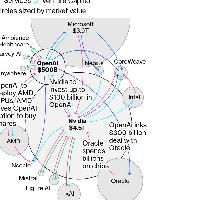
For much of the AI boom, there have been whispers about Nvidia’s frenzied dealmaking. The chipmaker bolstered the market by pumping money into dozens of AI startups, many of which rely on Nvidia’s graphics processing units to develop and run their models. OpenAI, to a lesser degree, also invested in startups, some of which built services on top of its AI models. But as tech firms have entered a more costly phase of AI development, the scale of the deals involving these two companies has grown substantially, making it harder to ignore.

Current growth is also “not coming from AI itself but from building the factories to generate AI capacity,” he added, suggesting that the tech industry is selling a still-hypothetical future rather than delivering a real one.
It’s true that investment in AI has reached a fever pitch lately. Earlier this week, AI chipmaker Nvidia announced that it’s pouring $100 billion into OpenAI as part of a “strategic partnership” to “build and deploy at least ten gigawatts of AI datacenters” — a deal that critics immediately slammed as self-serving.
“It may not be an exaggeration to write that NVIDIA — the key supplier of capital goods for the AI investment cycle — is currently carrying the weight of US economic growth,” Saravelos argued.
“The bad news is that in order for the tech cycle to continue contributing to GDP growth, capital investment needs to remain parabolic,” he concluded. “This is highly unlikely.”
OILab is an Amsterdam-based network of interdisciplinary scholars scrutinising political subcultures on the fringe corners of the Web. It does so by conducting empirical research based on digital methods as well as qualitative theoretical research. The results are usually papers and public appearances, but also take the form of more artistic projects. For write-ups of shorter projects, we also maintain a blog.
A command-line tool to copy a thread to a Markdown file and save all the media attachments in a directory.


American Eagle's "great jeans" ad led to a media outrage cycle after conservatives on X amplified a minority of liberal posts that claimed the ad had racist undertones.

Look in src/chores.json for list of chores. The "frequency" field is parsed like so:
1m = 1 month
3d = 3 days
2m15d = 2 months + 15 days
2y5m3w6d = 2 years + 5 months + 3 weeks + and 6 daysA javascript library to transform HTML document into beautiful print-ready pdf.
(Inter)governmental efforts to deal with the climate crisis are all based on a definition of technology that makes the consolidation of two incompatible aims—economic growth and environmental sustainability—seem possible. Technology is supposed to make the decoupling of economic growth from environmental depletion a reality. Technology has become a magic word granting us a way out of the climate crisis without changing anything fundamental. This specific definition of the word is invested with a strong—and well financed—drive to keep existing power structures in place. However, the paradox at the heart of this reading of technology has not gone unnoticed. The definition of the word technology in the climate crisis has become brittle; the mismatch with lived experience and material practices makes the word ‘uninhabitable’; giving rise to many new terms associated with communities of practice which give voice and shape to different definitions and roles for technology on a damaged Earth: permacomputing, computing within limits, collapse informatics, salvage computing, slow tech, redundant technology, low-tech, feminist technology, convivial computing, disability driven development and more.
Building on Keywords: A Vocabulary of Culture and Society by Raymond Williams (1976), I describe practices giving expression to different definitions of a single keyword, technology, by quite literally seizing control over the means of communication as the means of production. These communities of practice are not only taking control over the elements of network technology within their reach, they are also actively shaping the vocabulary used to discuss this. This dissertation aims to bring understanding of how the language around these infrastructures expresses this change, bringing the means of production in line with the interests of practitioners. Each practice, when situated historically, can teach us something about their transformative character and potential, which together constitute a low theory about questions emerging from these projects, fostering experimental togetherness, a pragmatic learning of what works and how (Graeber, 2004; Stengers, 2005). Exploring the contested meaning of technology—a word which holds a pivotal position in debates about ways to tackle climate change—can provide important insight into how this position emerged and support the experimental performing of other worlds that demonstrate computing otherwise is possible and doesn’t only consist of dreams, but also tests ideas in code, hardware and community organisation.
DSEG is a free font family, which imitate seven and fourteen segment display(7SEG,14SEG). DSEG have special features:

Instant rooms where voices and files move peer-to-peer, leaving no footprints. Built for privacy and digital autonomy, and against #chatcontrol

On the dark edge of all this has been the manosphere, the network of male supremacist websites, influencers and YouTube channels. The manosphere is confusing, because it’s a place where one can find both benign advice about protein consumption and ideas that have led to mass shootings. Its theories of evolutionary biology, mostly concerning what women were ‘built’ to do, are reposted on social media by people such as Musk. It’s annoying to have to take it seriously, just as it’s annoying to have to take the Taliban’s gender theories seriously. But in recent years the manosphere has forced us to pay attention through acts of extreme violence, and many of its advocates and theories have been taken up by democratically elected governments.